


Products
Engine oil filter: role, how it works and maintenance
24.08.2026
In any internal combustion engine, oil is a multifunctional fluid whose quality directly determines the performance and longevity of the engine. However, to fulfil its role effectively, it must remain clean throughout its service life. This is precisely where the oil filter comes into play: a crucial component whose performance directly affects the protection and service life of the engine.
What is the role of engine oil?
In any internal combustion engine – whether in a farm tractor, a construction machine or a road vehicle – the mechanical components are subjected to intense stresses: high speeds, extreme temperatures and high pressures. Without lubrication, these components would wear out within a matter of hours.
Engine oil fulfils four main functions:
- Lubrication: it forms a protective film between moving parts (pistons, camshafts, connecting rods, etc.), reducing friction and premature wear.
- Cooling: as it circulates through the engine, it absorbs and dissipates some of the heat generated by combustion and friction, complementing the coolant circuit.
- Corrosion protection: its additives neutralise the acids produced during combustion, thereby limiting chemical attack on metal surfaces.
- Cleaning: it carries suspended particles and residues to the oil filter, thereby keeping the engine components clean.
How does the oil circulate through the engine?
Before we can understand the importance of filtration, it is worth recalling the path that oil takes within an internal combustion engine. Far from being static, it is constantly in motion as soon as the engine is running.
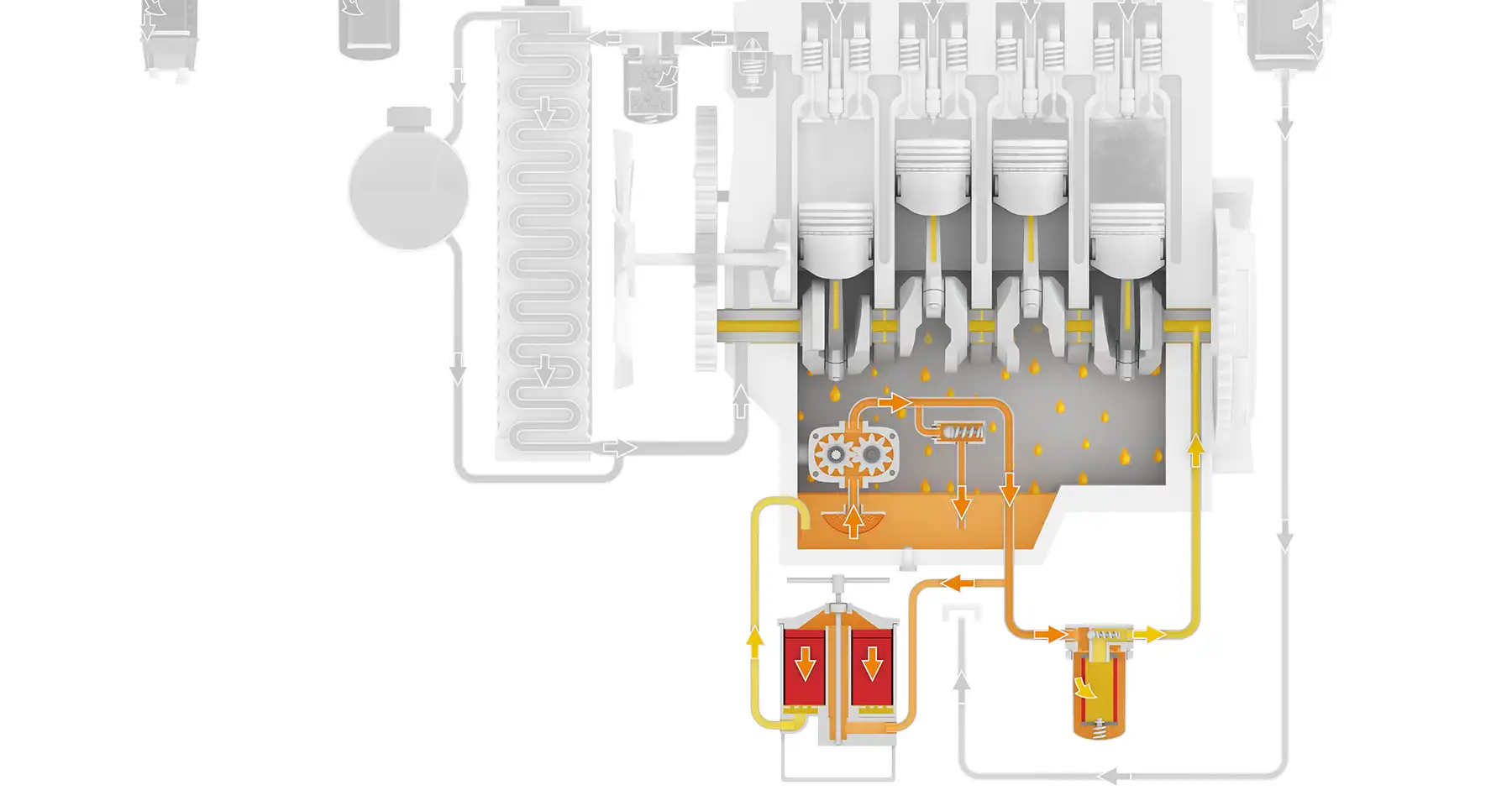
The cycle takes place in several stages:
- The reservoir: when the engine is at a standstill, the oil is stored in the sump, at the bottom of the engine.
- Suction: as soon as the engine starts, the oil pump draws oil through a strainer, which already traps the largest impurities.
- Pressurisation and filtration: the pump sends the oil under pressure to the oil filter. This is where filtration in the main circuit takes place: the entire flow passes through the filter before reaching the engine components. In the most demanding applications, a portion of this flow may also be diverted in parallel to an additional bypass filter with a very high filtration fineness (detailed further on).
- Distribution: the clean, pressurised oil is then channelled through the lubrication galleries to the components under load (crankshaft bearings, camshaft, rocker arms, turbocharger, etc.).
- The return flow: after lubricating, cooling and cleaning these components, the oil flows back down by gravity into the sump, where the cycle begins again.
This closed circuit operates continuously, several times a minute. This is why an effective filter is so important: any particle that is not trapped circulates repeatedly through the engine and contributes to the wear and tear of its components until it is captured.
Why does engine oil become contaminated?
The main sources of contamination include:
- Combustion residues: soot and carbon deposits produced by the combustion of fuel, which enter the crankcase via the clearance between the piston rings and the cylinder (blow-by).
- Metal particles: generated by friction between mechanical parts, they act as an abrasive that accelerates wear if they are not trapped.
- Moisture and condensation: particularly during cold starts, water vapour can condense in the oil and promote internal corrosion.
- Unburned fuel: in the event of poor combustion or frequent cold starts, traces of fuel can dilute the oil and reduce its lubricating properties.
- External contaminants – such as dust, sludge or various particles – may enter the system during maintenance operations.

Contaminated oil gradually loses its properties. It lubricates less effectively, does not dissipate heat as well and can itself become a cause of wear. Hence the importance of an effective oil filter and regular replacement.
Oil filter: protects the engine
The engine oil filter acts as a barrier between airborne contaminants and the engine’s sensitive components. It works by trapping solid particles present in the oil as it circulates through the system.
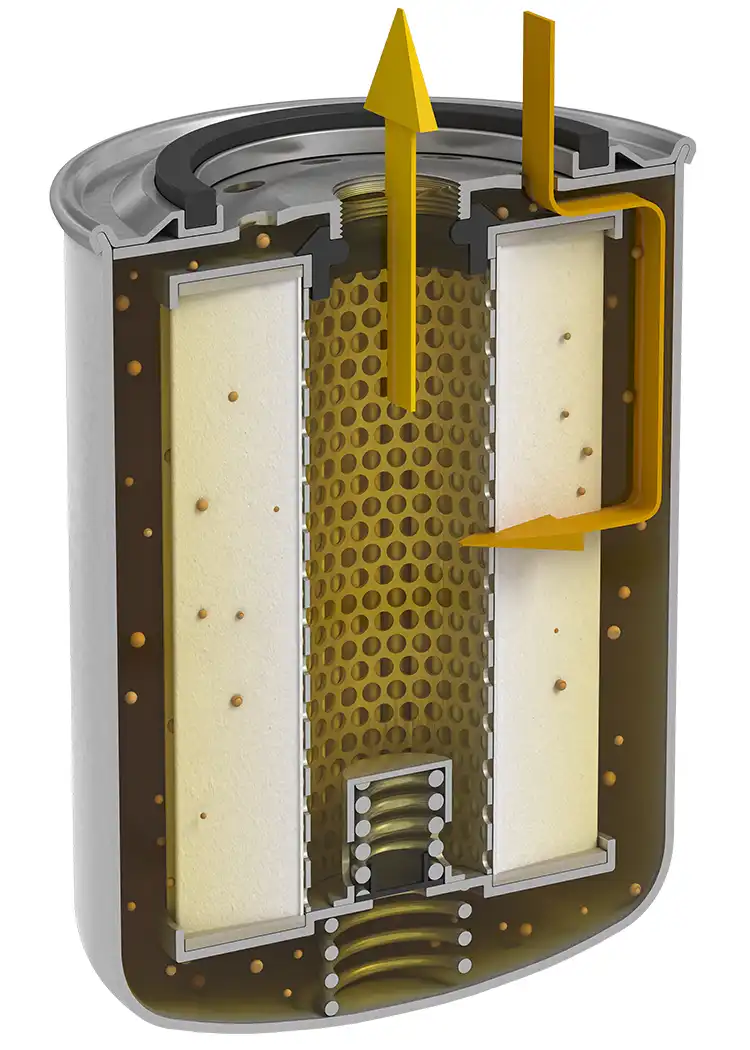
The performance of an oil filter depends on several factors:
Apart from its technical specifications, a filter will only protect the engine effectively if it is suitable for the application and replaced at the right time.
- Filtration fineness: expressed in microns, this determines the minimum size of the particles that are retained. The lower the figure, the finer the filtration.
- Retention capacity: the amount of contaminants that the filter can capture before becoming saturated.
- The type of filter media: cellulose, synthetic or a combination of both; each material offers different properties in terms of efficiency, pressure resistance and service life.
- The structure of the filter media: the media is usually pleated in order to maximise the filtration surface area within a compact space. The larger the filtration surface area, the greater the filter’s retention capacity and the lower the pressure drop, whilst minimising the space required.
- Integrated valves: depending on the model and circuit design, the filter may incorporate a non-return valve, which prevents oil from draining out during stoppages, and a safety bypass valve, which opens if the filter becomes saturated to maintain lubrication even in such circumstances.
Apart from its technical specifications, a filter will only protect the engine effectively if it is suitable for the application and replaced at the right time.
When should the engine oil filter be changed?
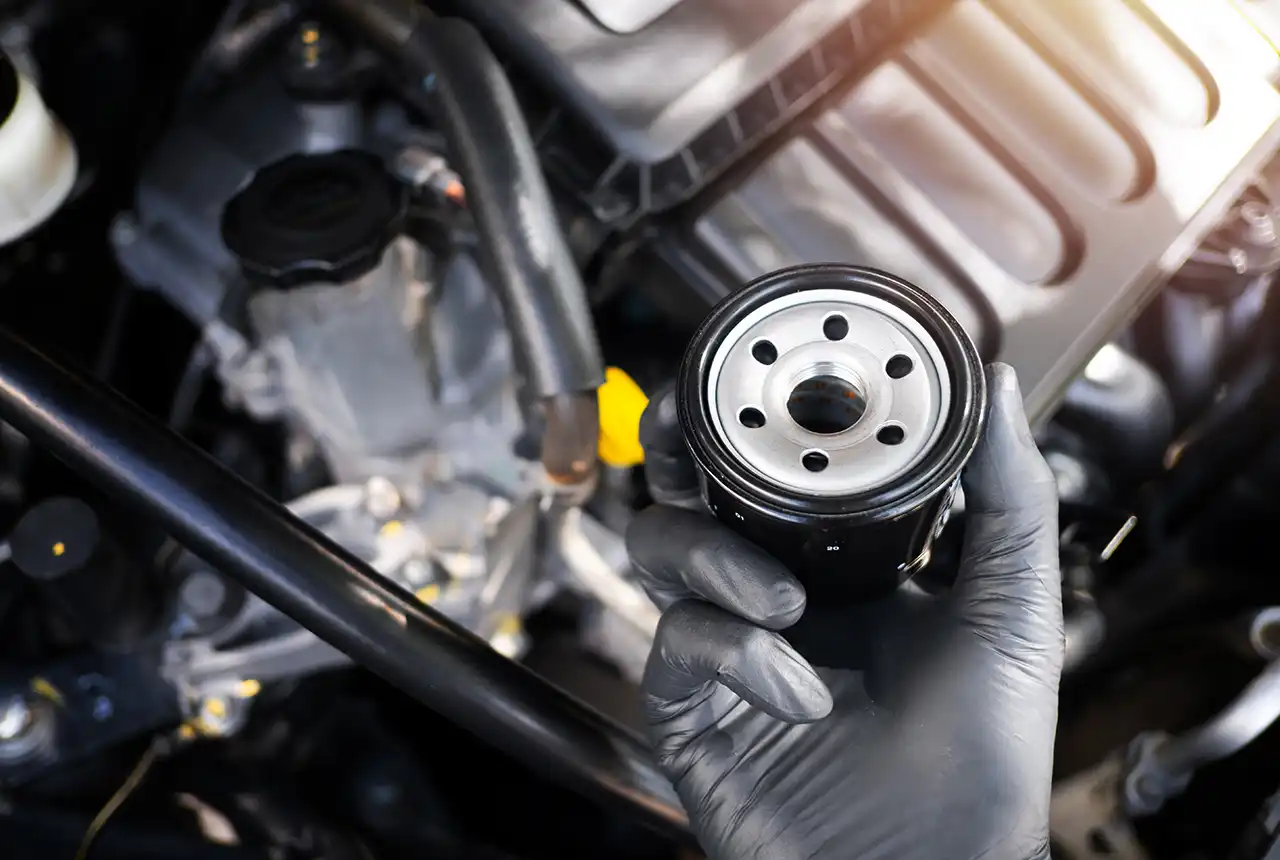
There are several warning signs that may indicate a problem with the oil circuit:
- Abnormally low oil pressure indicated on the dashboard
- Unusually high oil consumption
- Black, viscous oil when checking the level
- Increased mechanical noise when starting the engine
- Unusual exhaust smoke.
- The condition of the spark plugs, which can also provide an indication of the engine’s condition. For example, black or white spark plugs may be a sign of a problem requiring investigation.
“Don’t wait for these warning signs: preventive maintenance is always cheaper than an engine breakdown.“
HIFI FILTER® solutions for engine oil filtration
HIFI FILTER® offers an extensive range of engine oil filters compatible with all makes and models on the market: road vehicles, tractors, construction machinery, forestry machinery, material-handling equipment, marine and industrial applications.
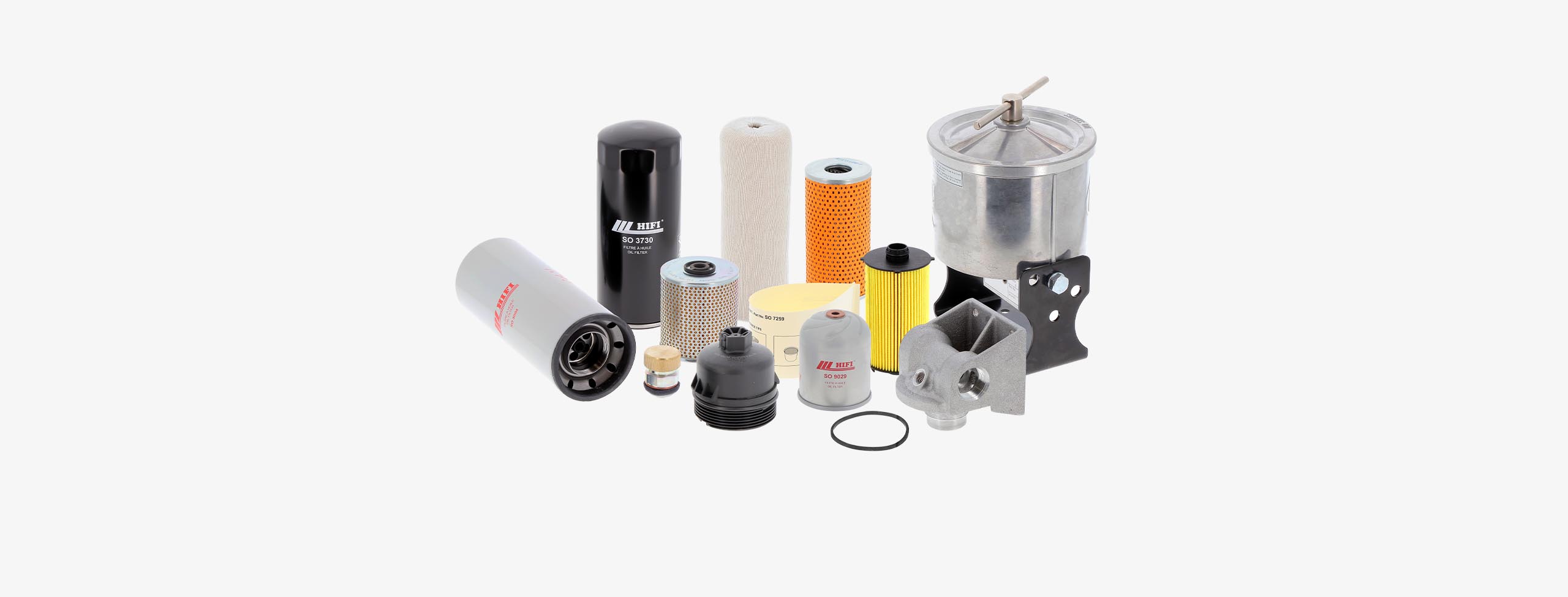
Several types of filters are available, depending on requirements and engine configurations:
The range also includes the accessories required for a complete oil change: magnetic quick-release drain plugs, seals, brackets and filter wrenches.
Our technical teams are on hand to help you identify the correct part numbers for your application.
- Spin-on oil filters: the most common type, combining the filter media and its metal housing into a ready-to-use unit. Depending on the application, it may incorporate a non-return valve and/or a safety bypass valve. Quick to replace, it is ideal for routine maintenance. Depending on the engine, it can be fitted on its own or in pairs in parallel, to increase retention capacity and filtration area.
- Cartridge oil filters: only the filter element is replaced, whilst the housing is reused. A more economical and environmentally friendly solution, which is increasingly favoured by manufacturers.
- Bypass filters: fitted in parallel to the main circuit, they supplement the standard filtration with a very high filtration precision for heavy-duty applications.
- Centrifugal filters: used in conjunction with the main filter in certain applications, they separate contaminants using centrifugal force. When spun at high speed, solid particles in the oil are flung against the wall of the bowl, where they accumulate on a paper insert to form a compact cake; the cleaned oil is then returned to the circuit. The insert, which is removed and replaced during servicing, simplifies maintenance.
The range also includes the accessories required for a complete oil change: magnetic quick-release drain plugs, seals, brackets and filter wrenches.
Our technical teams are on hand to help you identify the correct part numbers for your application.
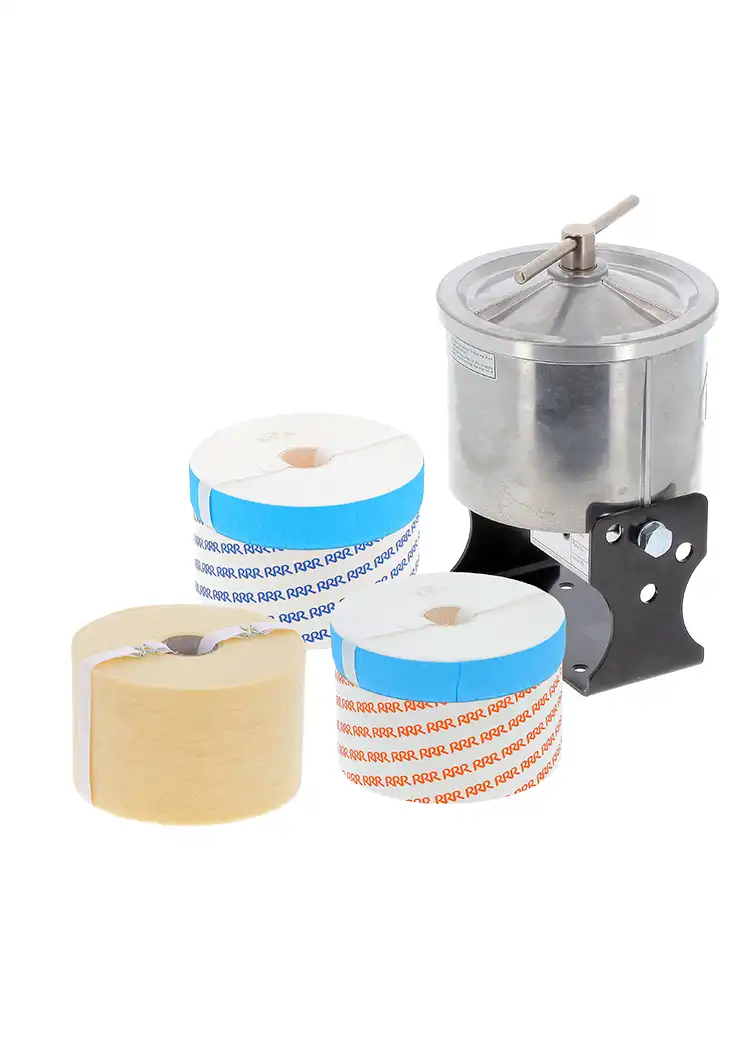
Additional bypass filtration: taking it one step further
For applications involving heavy-duty operation or engines subjected to intensive operating conditions, it is possible to go beyond standard filtration by adding an additional bypass filter. Fitted as a bypass on the main circuit, this filter continuously treats a fraction of the flow at a very high filtration fineness. In particular, it enables:
This solution is particularly well suited to high-power engines, applications operating continuously (cogeneration, generator sets) or vehicles travelling long distances.
- To remove ultra-fine particles, which are invisible to the naked eye but can cause abrasion to precision components.
- To absorb residual water contained in the oil, which is often a source of corrosion.
- To significantly improve the service life of the oil and the engine.
- To extend oil change intervals in certain configurations, thereby reducing maintenance costs.
This solution is particularly well suited to high-power engines, applications operating continuously (cogeneration, generator sets) or vehicles travelling long distances.
In summary
A high-quality engine oil filter, selected in accordance with the manufacturer’s recommendations and replaced at every oil change, ensures that the engine remains protected over the long term, whatever the operating conditions. In demanding environments, an additional bypass filter can further enhance this protection and optimise maintenance costs.
Our team is on hand to help you identify the parts that are compatible with your equipment.